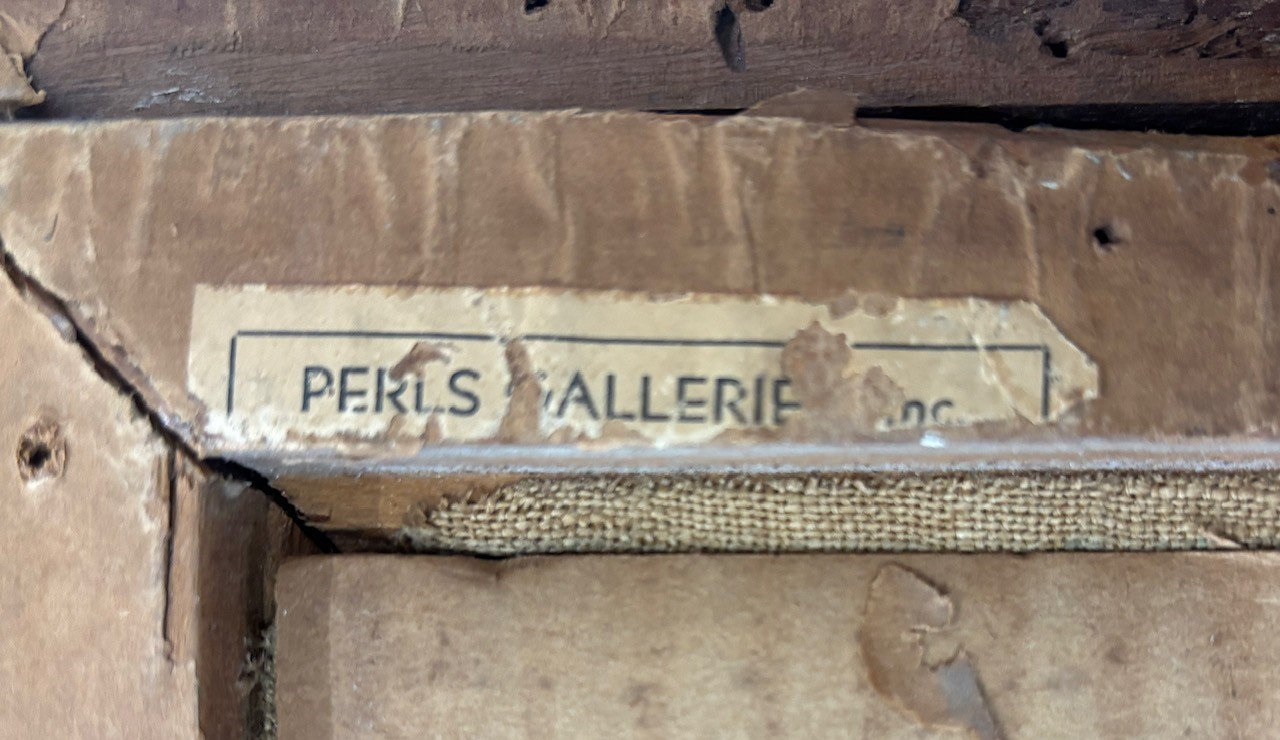
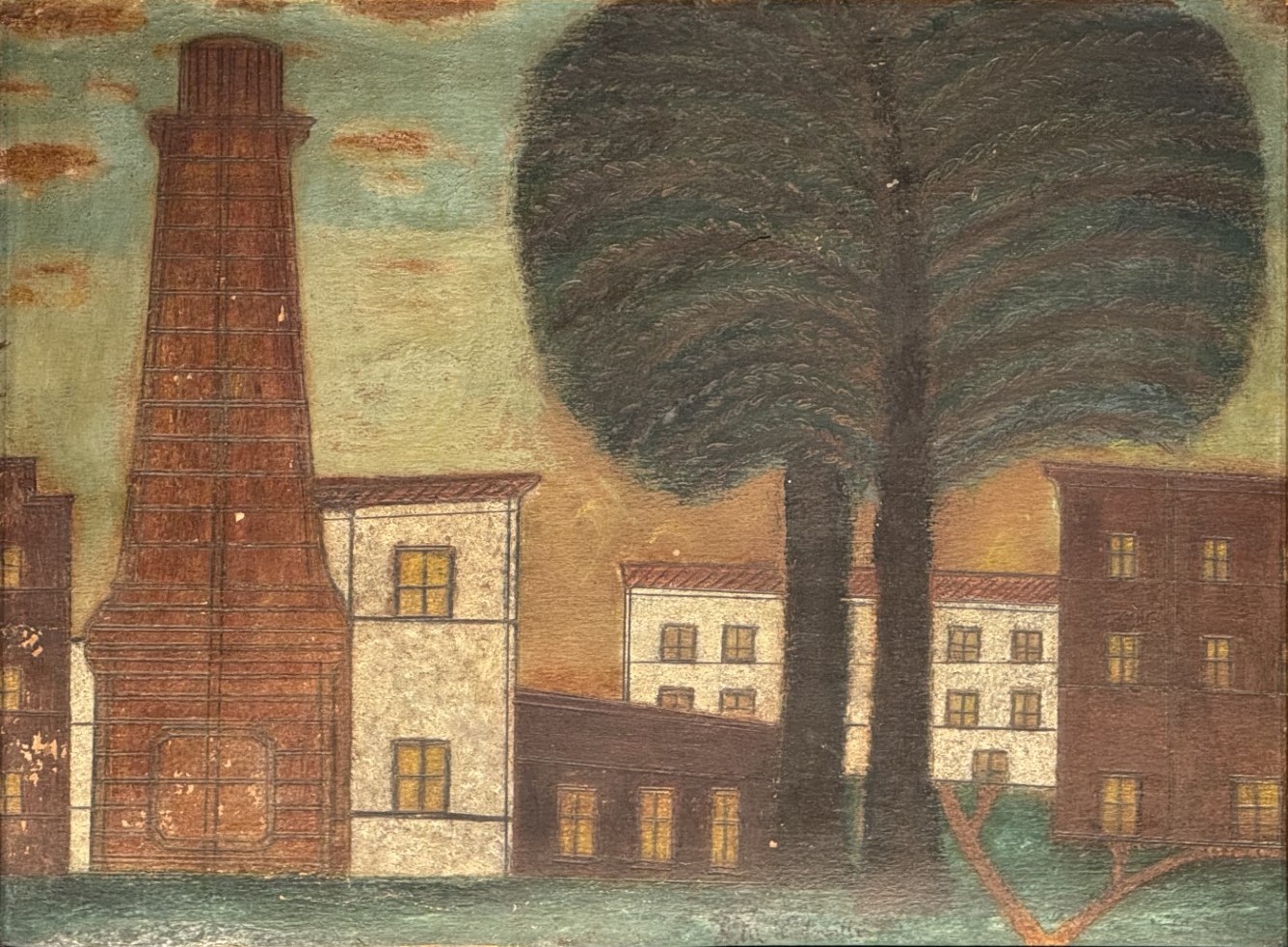
Antonio Vedovelli, Church and Tower, oil on cardboard, 15 by 19 inches, signed lower center. On verso, St. Augustine, Perls Gallery label.
Born in Italy Antony Vedovelli immigrated to the United States in 1893. He worked in Springfield, Massachusetts as a stonemason, bricklayer and gardener before retiring to St. Augustine in 1924. Robert Torchia in his book, Lost Colony, The Artists of St. Augustine, 1930-1950, tells us that Vedovelli, partly to relieve the boredom of his work caddying at the St. Augustine Golf Club, began to paint at night. His favorite subjects St. Augustine’s historic homes, churches and ships. Langston Moffett, a important early member of the St. Augustine art colony, and also self-trained, noted, that Vedovelli painted on everything he could get his hands on. Mostly on the backs of old cardboard boxes collected from the backyard of a next-door grocery. A primitive artist, Vedovelli’s work was first displayed at the Perls Galleries in New York City in 1945. Vedovelli specialized in scenes of St. Augustine which combined delicate outlines and low hued colors. Few of his paintings have been found. The St. Augustine Record, January 19, 1945, notes his work at a St. Augustine Arts Club exhibit, “Two of Antonio Vedovelli’s paintings in their primitive lines are on display. Mr. Vedovelli is a local resident who has recently won recognition in New York City. He was born an Italian peasant and never painted until a few years ago. He has already reached his 75th year.” The Record continued, January 16, 1946, “At the present time there is considerable interest in the self-taught or primitive painters, as they are called. The work of Antonio M. Vedovelli is not entirely unknown in this city, and he has had a most successful one man show in New York recently. ‘The Village’ is an interesting arrangement in color and form as well as having great vitality. Many modern artists have taken a leaf from the notebooks of these painters, but they still do not possess the innate something which makes their work so unusual and intriguing. ‘The Church’ is an impression of Trinity and is done in rich colors of low tone. If you want to see color at work, notice that little spot of the red brick wall in the lower left of the canvas. It just helps to make the picture.” Born: 1868, Verona, Italy. Died: 1953. Membership: St. Augustine Arts Club. Exhibits: Perls Galleries, New York City, 1943; Society of The Four Arts, January 1945, Fort Entrance; St. Augustine Arts Club, January 1945; SAAC, January 1946, The Village, The Church; SAAC, February 1946, Before the Storm, The Cathedral, The Hamblen Club; SAAC, March 1946; SAAC, February 1947, Old Water Supply, Part of Castillo de San Marco; Corcoran Galleries, Washington, D.C., 1947; SAAC, January 1948, Buildings.
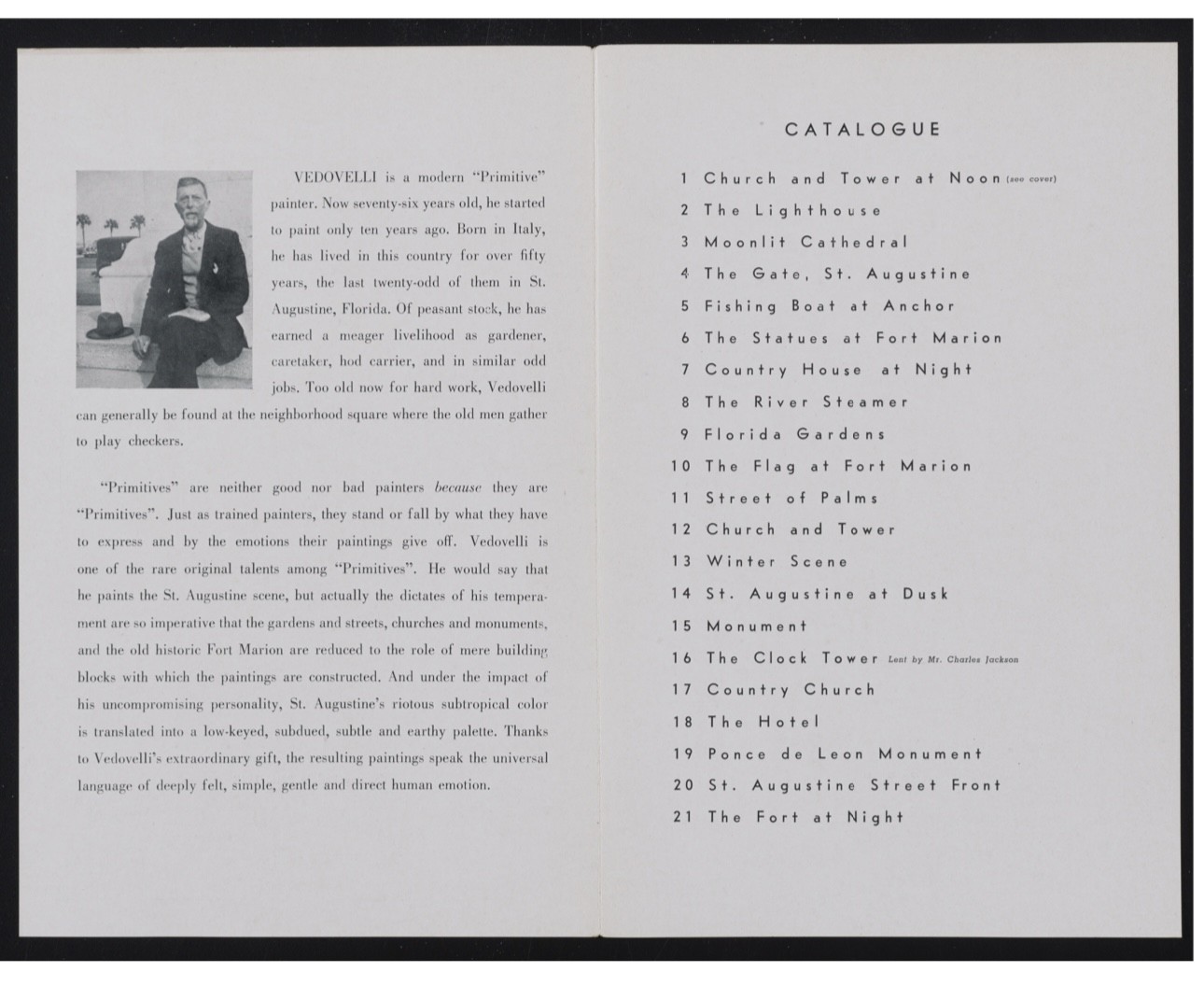
Recently Fort Lauderdale attorney Scott Schlesinger found the above painting, possibly Church and Tower, listed in the Perls Gallery Catalogue and attached below, and a remarkable article on Vedovelli published in Newsweek January 8, 1945.
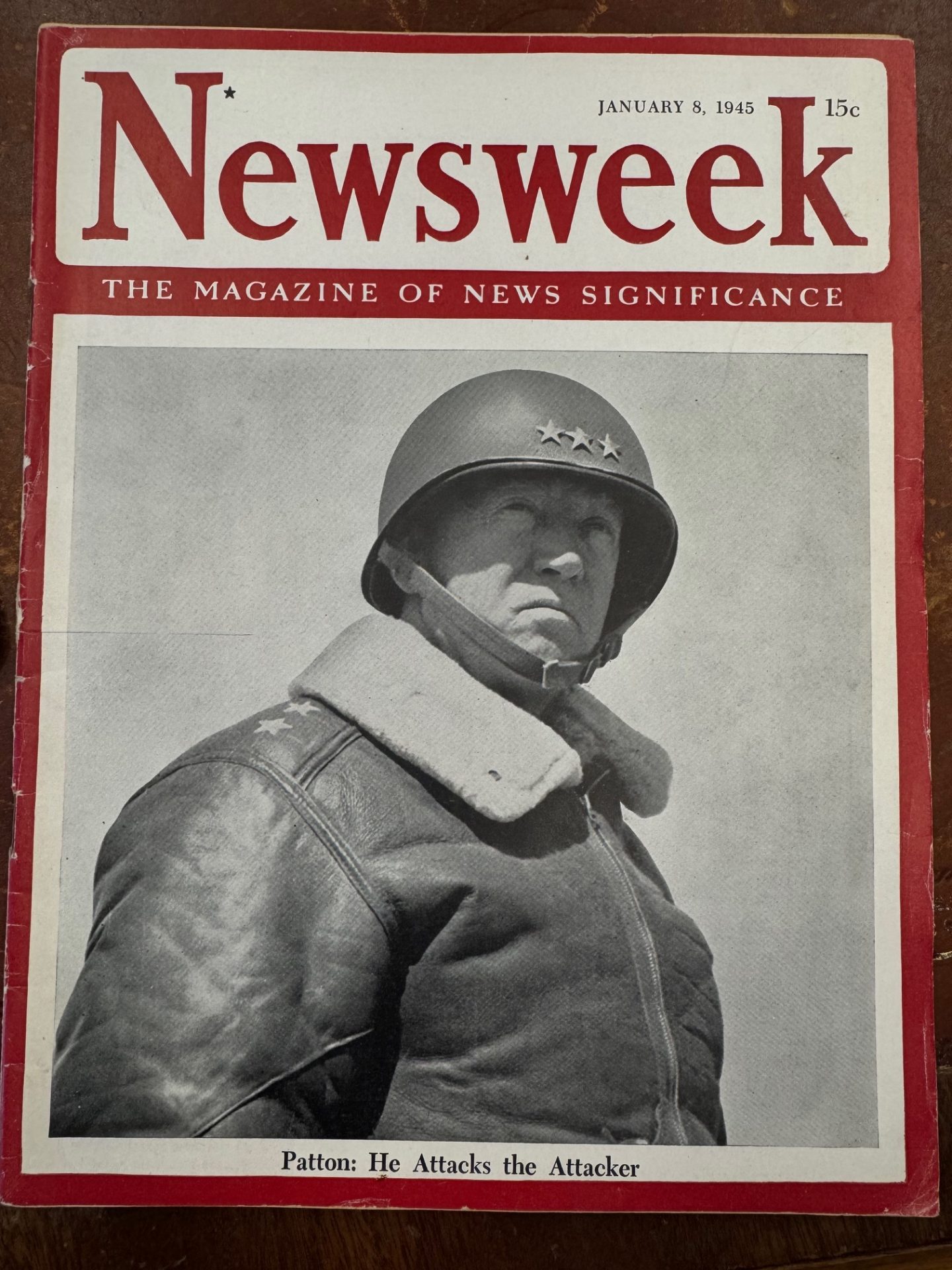 Newsweek, January 8, 1945
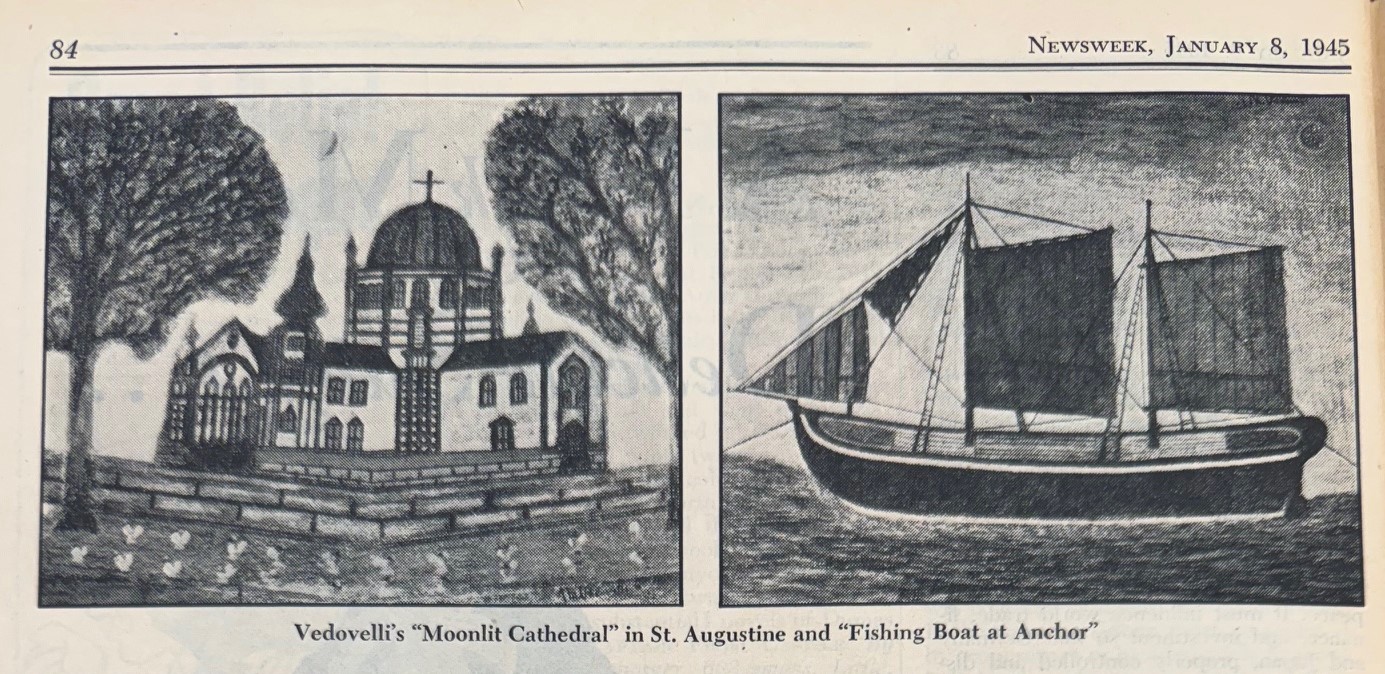
The cherished dreams of most unestablished artists is a New York one-man show. Antonio M. Vedovelli, 76-year-old retired caretaker of St. Augustine, Fla., whose only previous showing was at Walgreen drugstore there, has one now at the Perls Galleries, New York. But he is completely unimpressed. The publicity means little,” he says. “Money is important, but it’s subordinate to knowledge and beauty.”
Vedovelli is a completely untaught primitive who paints what he thinks are photographic representations. Actually, like all good artists, he rearranges nature’s forms and colors into beautiful compositions. He constructs St. Augustine’s churches, monuments, and quaint old buildings with a meticulous delicate, yet firm line often aided by the ruler. He formalizes the lush subtropical flowers and paints palm trees in the same rounded, solid shapes that children draw. His low-hued colors (unlike St. Augustine’s actual brilliance) are subtle and sophisticated. The paintings are romantic but they nevertheless look like St. Augustine.
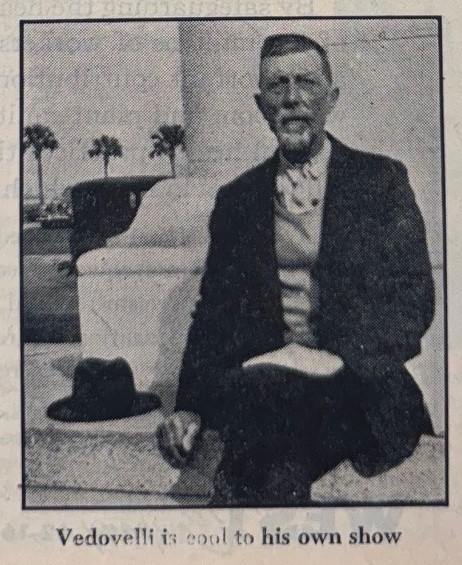
Vedovelli never paints people, perhaps because the dignified, courtly old man doesn’t care for them. A town character, the bearded artist hangs out with the other elderly men in the city’s old slave market. Most of the townspeople know and like him, but he has no close friends. He explains: “I’m polite to all people, but I believe you can never become intimate with anyone as people are two-faced.”
Honeymoon Discovery: Vedovelli particularly distrusts women, and his conversion is peppered with derogatory statements as, “they are like cats, and if they’re not watched they’ll scratch you” and “they all have beauty and no brains.” He has never married.
Ironically, Vedovelli owns his own “discovery” to another man’s honeymoon. The summer before last Tom Sterling, then an Army sergeant stationed in St. Augustine (he is now assistant secretary of the New York State Chamber of Commerce) was married there to an art-loving young writer from New York. After the ceremony the couple, to celebrate, went into a Walgreen drugstore for ice cream. There, high above the ads for malteds, they notice Vedovelli’s paintings.
Later, walking trough the street, they saw an old man painting his fence with the same primitive flowers and little designs. They introduced themselves. Vedovelli invited the young couple to his tin house to see more.
It was neat, shabby, and crowed, with a layer of dust over everything and paintings everywhere. The Sterling’s were amazed at the beauty of the paintings. They were even more astonished, however, at the artwork crammed between them on the walls, pin-up girls from Esquire, beer-ad girls such as Miss Rheingold of 1941. They ended by buying one painting:” Church and Tower at Noon, “which now adorns the catalogue of Vedovelli’s show. And it was they who introduced his work to Pearls.
Vedovelli’s outlook for his show is skeptical, “To Sterling he wrote doubtfully: “I can only wish to the Perls gallery owner good luck and success, as for me I am too old and my time is over about painting so I don’t look for future glory.” One painting was sold even before the opening this week. It was “The Clock Tower,” bought by Charles Jackson, author of “The Lost Weekend.”
Copy from the Perls Catalogue below.
Vedovelli is a modern “Primitive painter. Now seventy-six years old, he started to paint only ten years ago. Born in Italy he has live in this country for over fifty years, the last twenty-odd of them in St. Augustine, Florida. Of peasant stock, he has earned a meager livelihood as gardener, caretaker, hod carrier, and in similar off jobs. Too old now for hard work, Vedovelli can generally be found at the neighborhood square where the old men gather to play checkers.
Primitives” are neither good nor bad painters because they are “Primitive.” Just as trained painters, they stand or fall by what they have to express and by the emotions their paintings give off. Vedovelli is one of the rare original talents among “Primitives.” He would say that he paints the St. Augustine scene, but actually the dictates of his temperament are so imperative that the gardens and streets, churches and monuments and the old historic Fort Marion are reduced to the role of mere building blocks with which the paintings are constructed. And under the impact of his uncompromising personality, St. Augustine’s riotous subtropical color is translated into a low keyed, subdued, subtle and earthy palette. Thanks to Vedovelli’s extraordinary gift the resulting paintings speak the universal language of deeply felt, simple, gently and direct human emotion.