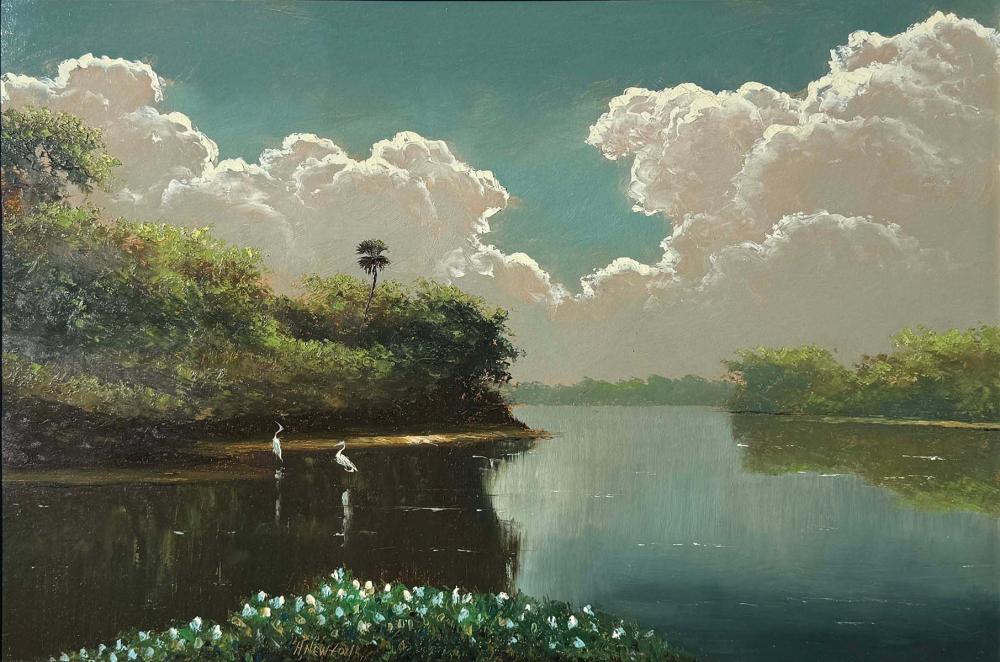
Harold Newton, oil on Upson board, 28 by 48 inches. Signed lower right.
Harold Newton was the first of a group of African American artists known as the Highwaymen. In 1953 Newton approached Ft. Pierce artist Beanie Backus for advice. They met, and Backus convinced him to give up religious painting and concentrate on landscapes. Newton never studied with Backus. He is classified with the Highwaymen but as an independent black artist in temperament and demeanor, he was never really with them. Like the Highwaymen, his technique resembled Backus. Newton using inexpensive materials, sold his work door to door for $25, and produced thousands of paintings. Although prolific, Newton’s paintings are some of the finest of Highwaymen art.
Andrew James “Harold” Newton was born in Gifford, the African American community in Vero Beach, but raised in Tifton, Georgia where he was brought up through the church in a Christian family. While in the 7th grade young Newton found he could earn money selling religious paintings done on velvet to local churches, sometimes for as much as $2.50. To get his thoughts set for this work young Harold would read the Bible, verse after verse, and place in his mind a picture of Christ talking to His disciples and imitate the thought with his brush and oils. But there weren’t many churches in Tifton. When his father died, to help care for his family, Newton was forced to leave school after finishing the 9th grade. He found fulltime work on a farm. Newton would put in a heavy day in the fields and continue his drawings at night by kerosene lamp light.
About the age of 18 Newton was married, and with some of the money earned from farm work, purchased oil paints, and sold his first paintings, “of the historical type to higher ups in Georgia” …for four or five dollars apiece,” a great help to his family, and enough to pay his way back to Vero Beach. Newton is quoted by the Bradenton Herald, July 1, 1958. “Things were tough, it was hard to earn a living, so I told my mamma I was going back to Gifford where I was born.”
Earning a living as a professional artist is not always easy and can take years. Imagine how it must have been for Harold Newton. At the time everything was segregated—white and black bathrooms, water fountains, schools, restaurants, hotels, everything. There were few black artists in Florida in 1953. It was a difficult time—two years before Rosa Parks would refuse to give up her seat on a bus to a white man, ten years before the Selma freedom marches, twelve years before Martin Luther King’s “I have a dream” speech.
Newton’s first public recognition as an artist came when the Indian River Press- Journal, January 28, 1954, published a photograph of him, along with Bob Curzon, Press-Journal Sports Editor, holding one of Newton’s canvases. The caption reads, “Harold Newton 19-year-old Spruce Park Negro, proudly displays a tropical oil painting he recently finished. Newton, who has had no formal art training, has an uncanny knock of capturing the beauty of Florida on canvas. Many local people who have seen the young Negro’s work are hoping that some arrangement can be made to sponsor his art schooling.” By the summer of 1955 the Indian River County Court house was boasting, “Harold Newton, talented Negro artist, has brought culture and appreciation of the arts to the courthouse. Several of the County offices now boast oils by Newton.”
Hearing that there were great artists in Sarasota and Bradenton, in the Spring of 1958 Newton moved to Newtown, an African American community in Sarasota, bringing with him some of his best paintings. Working out on Longboat Key, he painted landscapes and seascape by request and sold over 100. In July the Citizens Bank of Sarasota had five of his paintings on display, and in August, a showing at the Sarasota Federal and Trust Company Community Galleries. Martha Van Vleck Bradenton Herald staff writer said, “Newton is gaining a reputation in these parts despite the fact that he has been on this coast for only four months. Someday, when enough paintings have been sold, Newton hopes to finance his way to training with an artist in Fort Pierce. Until then you are likely to find the young dark-skinned artist prowling about the bayous, seashores, or roadway in search of things to paint. We wish him well as an artist and as another who has come out ahead… against the odds.”
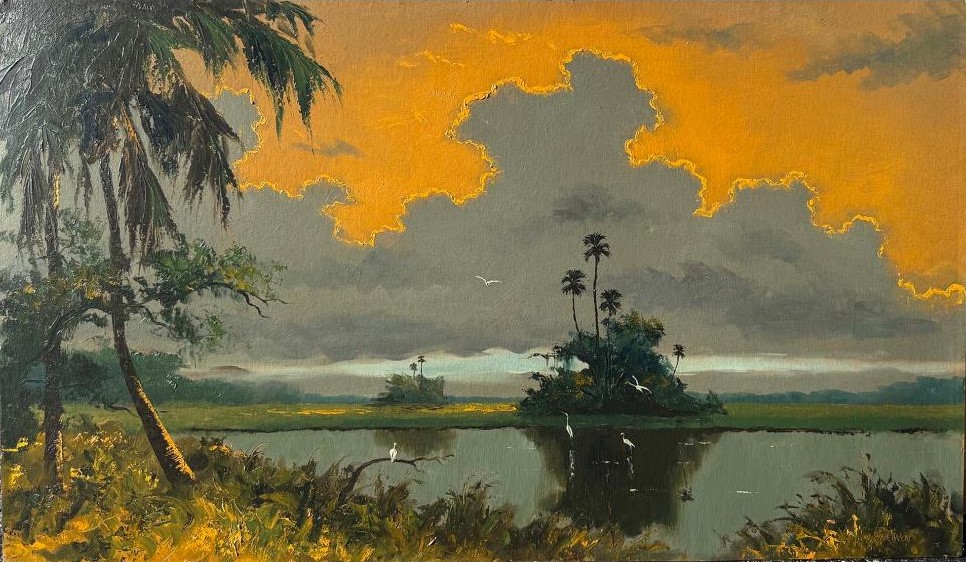
Harold Newton, oil on Upson board, 28 by 38 inches. Signed lower left.
It is an amazing story given the times, Newton a “dark-skinned” artist, living in a segregated section of Sarasota, while painting out on the white beaches of Longboat Key.
Newton was moving around the state when the Miami Herald Fun in Florida Magazine (Sunday, February 15, 1959) published the following by staff writer Marjorie Silver.
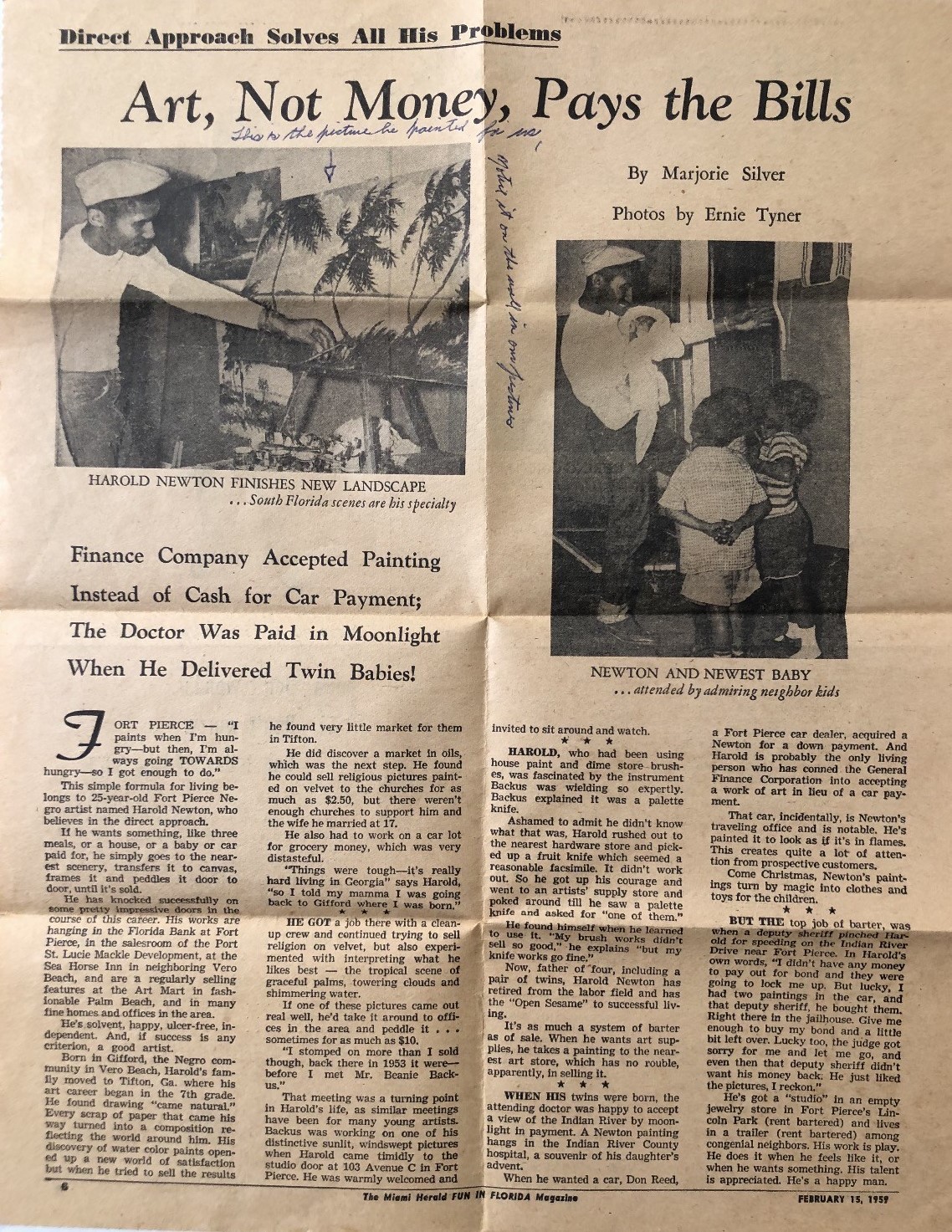
Art, Not Money, Pays the Bills.
Fort Pierce— “I paints when I’m hungry—but then, I’m always going “Towards hungry—so I got enough to do. “This simple formula for living belongs to 25-year-old Fort Pierce Negro artist named Harlod Newton, who believes in the direct approach. If he wants something, like three meals, or a house, or a baby or car paid for, he simply to the nearest scenery, transfers it to canvas, frames it, and peddles it door to door until it’s sold.
He has knocked successfully on some pretty impressive doors in the course of his career. His works are hanging in the Florida Bank at Fort Pierce, in the salesroom of the port St. Lucie Mackle Development, at the Sea Horse Inn in neighboring Vero Beach, and are a regularly selling feature at the Art Mart in fashionable Palm Beach, and in many fine homes and offices in the area. He’s solvent, happy, ulcer-free, independent. And, if success is any criterion, a good artist.
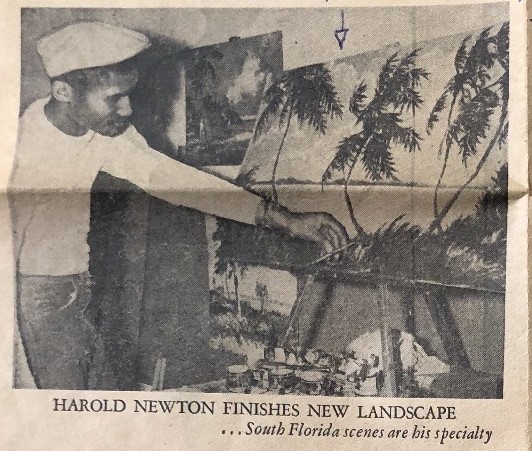
Born in Gifford, the Negro community in Vero Beach, Harolds family move to Tifton, Georgia. Where his art career began in the 7th grade. He found drawing “came natural.” Every scrap of paper that came his way turned into a composition reflecting the world around him. His discovery of watercolor paints opened a new world of satisfaction, but when he tried to sell the results, he found very little market for them in Tifton.
He did discover a market in oils, which was the next step. He found he could sell religious pictures panted on velvet to the churches for as much as $2.50, but there weren’t enough churches to support him and the wife he married at 17. He also had to work on a car lot for grocery money, which was very distasteful. “Things were tough—it’s really hard living in Georgia” says Harold, “so I told my mamma I was going back to Gifford where I was born.”
He got a job there with a cleanup crew and continued trying to sell religion on velvet but also experimented with interpreting what he likes best—the tropical scene of graceful palms, towering clouds, and shimmering water. If one of these pictures came out really well, he’d take it around to offices in the area and peddle it…sometimes for as much as $10. “I stomped on more than I sold though back there in 1953 it were—before I met Mr. Beanie Backus.” That meeting was a turning pint in Harold’s life, as similar meetings have been for many young artists.
Backus was working on one of his distinctive sunlit, windswept pictures when Harold came timidly to the studio door at 103 Avenue C in Fort Pierce. He was warmly welcomed and invited to sit around and watch. Harold, who had been using house paint and dime store brushes, was fascinated by the instrument Backus was wielding so expertly. Bakus explained it was a palette knife.
Ashamed to admit he didn’t know what that was, Harold rushed out to the nearest hardware store and picked up a fruit knife which seemed a reasonable facsimile. It didn’t work out. So, he got up his courage and went to an artists’ supply store and poked around till he saw a palette knife and asked for “one of them.” He found himself when he learned to use it. “My brush works didn’t sell so good,” he explains “but my knife works go fine.”
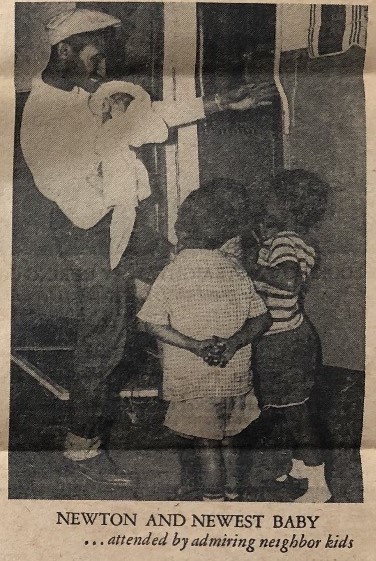
Now father of four, including a pair of twins, Harold Newton has retired from the labor field and has “Open Sesame” to successful living. It’s as much a system of barter as of sale. When he wants art supplies, he takes a painting to the nearest art store, which has no trouble apparently, in selling it.
When his twins were born, the attending doctor was happy to accept a view of the Indian River by moonlight in payment. A Newton painting hangs in the Indian River County hospital, a souvenir of his daughter’s advent. When he wanted a car, Don Reed, a Fort Pierce car dealer, acquired a Newton for a down payment. And Harold is probably the only living person who has conned the General Finance Corporation into accepting a work of art in lieu of a car payment. That car, incidentally, is Newton’s traveling office and is notable. He’s painted it to look as if it’s in flames. This creates quite a lot of attention from prospective customers.
Come Christmas, Newton’s paintings turn by magic into clothes and toys for the children. But the top job of barter, was when a deputy sheriff pinched Harold for speeding on the Indian River Drive near fort Pierce. In Harold’s own words, “I didn’t have any money to pay out for bond and they were going to lock me up. But lucky, I had two paintings in the car and that deputy sheriff, he bought them. Right there in the jailhouse. Gave me enough to buy my bond and a little bit left over. Lucky too, the judge got sorry for me and let me go, and even then, that deputy sheriff didn’t want his money back. He just liked the pictures, I reckon.”
He’s got a “studio” in an empty jewelry store in Fort Pierce’s Lincoln Park (rent bartered) and lives in a trailer (rent bartered) among congenial neighbors. His work is play. He does it when he feels like it, or when he wants something. His talent is appreciated. He is a happy man.
 Education: Tifton County Industrial High School, Tifton County, Georgia; with Beanie Backus. Born: October 30, 1934, Gifford, Florida. Died: June 1994. Membership: Vero Beach Art Club. Education: Exhibits: Soroptimist Club, 2nd Annual Outdoor Art Exhibit, February 22, 1954; Vero Beach Art Club at Community Center, March 1954; Vero Beach Art Club at Community Center, March 1955, 3rd prize amateur; Citizens Bank of Sarasota, July 1958, 5 paintings; Sarasota Federal and Trust Company Community Galleries. August 1958.