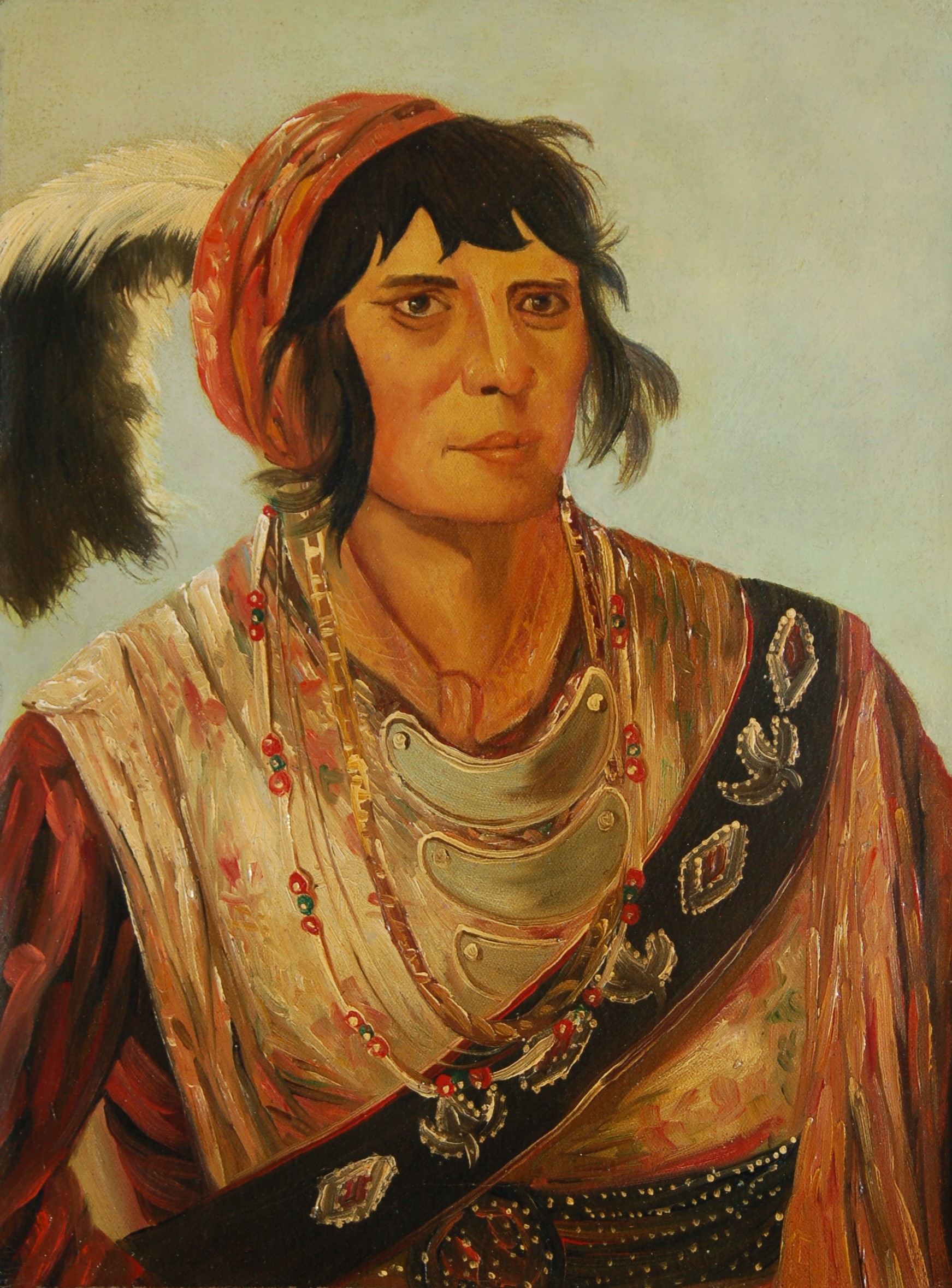
The original portrait of Osceola, The Black Drink, a Warrior of Great Distinction, was painted by George Catlin at Fort Moultrie, near Charleston, South Carolina, in January 1838. Today it hangs in the Smithsonian American Art museum, in Washington, D.C.
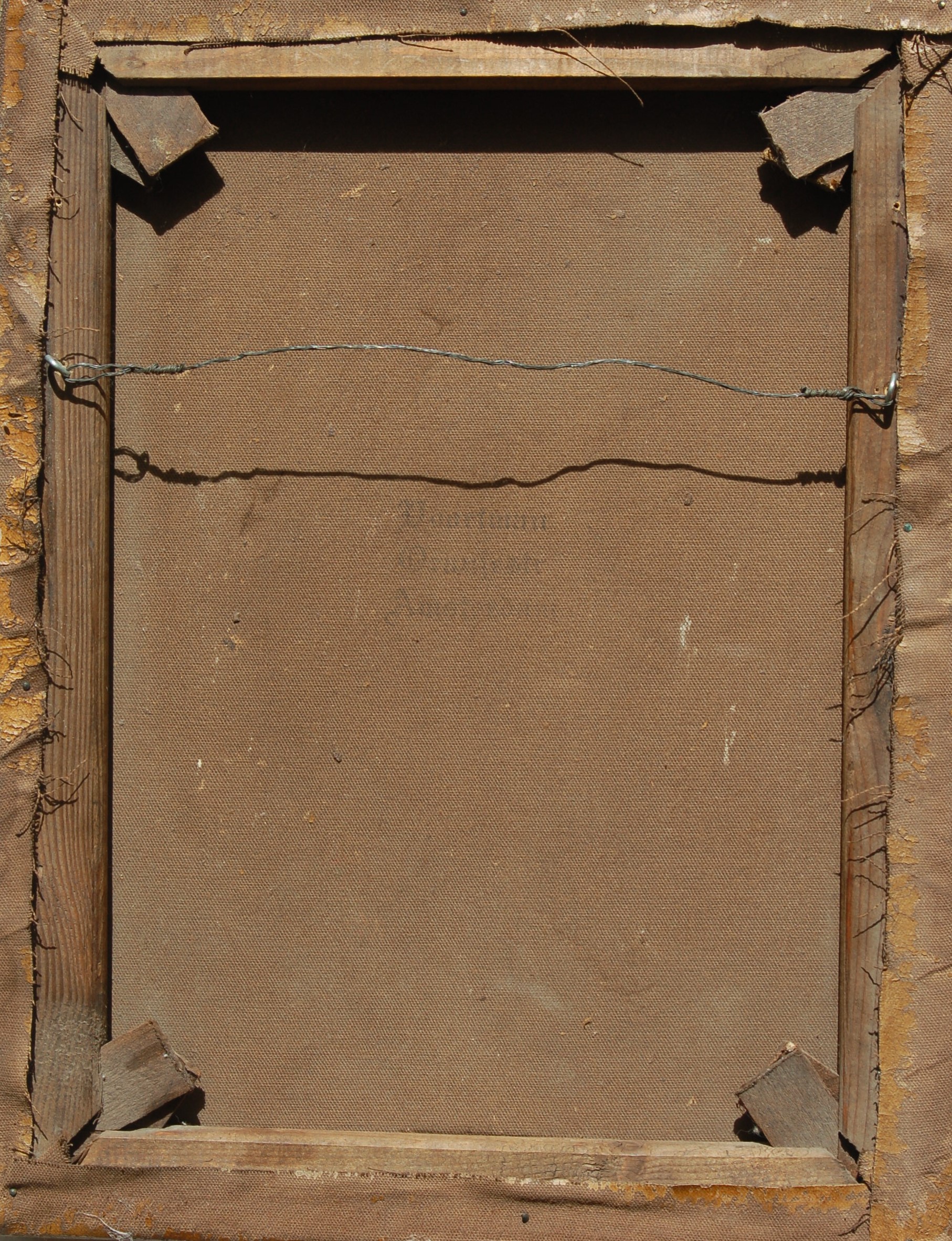
I believe this portrait of Osceola, sold as attributed to Geroge Catlin, could be an original copy painted by Catlin himself for the British book collector Sir Thomas Phillipps some one-hundred and seventy-five years ago when Catlin was living in Belgum. The painting measuring 16 by 12 inches is held in an old stretcher by corner keys. The canvas has a Dutch suppliers stamp—Voortman Oraniestr Amsterdam. The painting is not signed or dated. Here is my reasoning to date.
Catlin exhibited his famed American Indian Collection in New York City before sailing to England in 1840. In London he opened his collection at Egyptian Hall, Piccadilly. In July Catlin met famed book collector Sir Thomas Phillipps. Phillipps would many years later be remembered as “The World’s Greatest Book Collector.” A. N. L. Munby, author of the five-volume Phillipps Studies, says that Phillipps developed a “warm fellow-feeling for Catlin…that would last over twenty-years.” And Joan Carpenter Troccoli, in her book First Artist of the West, George Catlin Paintings and Watercolors, notes Catlin called Phillipps, “my only patron.”
Phillipps tried to help with the publication of Catlin’s book, Illustrations of the Manners, Customs and Condition of the North American Indians, 2 vols. (1841). Phillipps continued to supported Catlin’s efforts in England until April 1845 when, due to lack of pubic support, Catlin left for Paris.
Catlin returned to London in 1848 heavily in debt. Phillipps lent Catlin one hundred Pounds, for which the artist left Phillips, as security, twenty original paintings from his collection. In December 1850 Phillipps sent a note to Catlin, “My dear Sir, I am extremely sorry to hear of you bad success…. I am in the greatest distress for money and your 100 Pounds would be most serviceable…. But if I were to take it out in paintings how many would you do for me to discharge it?” On March 31, 1851 Phillipps sent a list of fifty-five paintings he wanted copies of…the paintings were to be oil on canvas 16 by 13 inches. Catlin informed Phillipps on November 27, 1851 that he had nearly completed the 53. On November 7, 1853, Phillipps noted the safe arrival of the paintings at his home at Middle Hill, near Broadway, Worcestershire. Catlin was living in Brussels, Belgium.
Always in debt, in 1858 Phillips purchased 50 watercolors made for Catlin’s Souvenir of the North American Indians as They Were, in the Middle of the Nineteenth Century.
In 1863 Phillipps moved his collection from Middle Hill to Thirlestaine House in Cheltenham. The move took two men and 105 wagon loads drawn by two horses, eight months to complete. On August 11, 1863 in a letter to a friend, Phillips noted, “I have established as my Indian Gallery containing 50 or 60 pictures by Mr. George Catlin, illustrative of Indian manners and scenes in North America.”
Baronet Sir Thomas Phillipps died in 1872. Phillipps’ son in law John Fenwick began the task of liquidating the huge estate. In the early1880’s Fenwick’s son Thomas FitzRoy Fenwick took over with a sale at Sotheby in London. His custodianship finally ended with the advent of World War II.
Thirlestaine House, the home of the collection, was taken over by the Ministry of Aircraft Production and the library crated up and stored. In 1945 what remained of the Phillipps Collection was sold to the bookselling house of William H. Robinson, Ltd, of Pall Mall. In 1946 the Robinson’s sold what remained of Catlin’s “Indian Gallery” to Thomas Gilcrease. The Gilcrease Museum in Tulsa, Oklahoma has 137 Catlin watercolors and 76 of his oil painting, many of the oil paintings are 11 1/8 by 14 5/8 inches, and most not signed or dated.
The Yale Center for British Art has a Catalogue of the gallery of paintings of Sir Thomas Phillipps, Bart. At Thirlestaine House, Cheltenham, 1866. (7 pages). I obtained a copy of this 1866 Catalogue. The 7-page catalogue lists 399 paintings in the Phillips Collection. Prominently on page 4 and in capital letters is “The CATLIN GALLERY, George Catlin’s Sketches of Indians in N. America.” Of the 62 Indian sketches, numbered 180 to 242, only one is a portrait and that is the first, number 180, titled “Portrait of an Indian Chief.” These sketches are at the heart of the Catlin Collection at the Gilcrease Museum.
Could this “Portrait of an Indian Chief” be Osceola? Given Osceola’s fame at this time, it is certainly possible that Osceola’s portrait would be displayed prominently. Catlin called Osceola “An extraordinary character…. who acquired an influence and a name that soon sounded to the remotest parts of the United States, and amongst the Indian tribes, to the Rocky Mountains.”
This Osceola portrait was auctioned by the Wooton Auction Rooms, March 9, 2021, as: “This version probably from the late 1860’s–cartoon collection when Catlin was based in Europe (Brussels).” Four other lots possibly from the same consignee included a watercolor of Kwakwaka’wakw Spirit Bird, Pacific Northwest American; watercolor, North American Indian with hunting dog, spear, and gunstock club; and 2 steel engravings drawn by Charles Bodner, Ptihn-Tak-Ochata, Dance of the Mandan Women and Decota women and girl. The cartoon collection is reported to be all oil on artist board.
The Wotton Auction Rooms is located at Tabernacle Road, Wotton-under-Edge, Gloucestershire, England, just 21 miles from Thirlestaine House.
I plan to radiocarbon date the stretcher of the Osceola painting. The wood will have to be from trees at least 176 years old if this Osceola portrait was done in 1850-51.
Finally, there must be a careful comparison of this Osceola with the 20 odd oils on canvas portraits in the Gilcrease Catlin collection. Are any painted on Voortman Oraniestr Amsterdam canvas? I will be contacting them.
Fred Frankel
April 6, 2026
Sarasota, Florida
George Catlin painted Seminole warrior Osceola at Fort Moultrie, near Charleston, South Carolina, in January 1838. Catlin wrote about Osceola:
“This young man is no doubt an extraordinary character, as he has been for some years reputed and doubtless looked upon by the Seminoles as the master sprit and leader of the tribe….From his boy hood, he had led an energetic and desperate sort of life, which had secured for him a conspicuous position in society; and when the desperate circumstances of war were agitating his country, he at once took a conspicuous decided part, and acquired an influence and a name that soon sounded to the remotest parts of the united States, and amongst the Indian tribes, to the Rocky Mountains.“
“Commonly called Powell . . .[he] is generally supposed to be a half-breed, the son [grandson] of a white man . . . and a Creek woman . . . I have painted him precisely in the costume, in which he stood for his picture, even to a string and a trinket. He wore three ostrich feathers in his head, and a turban made of a varicolored cotton shawl—and his dress was chiefly of calicos, with a handsome bead sash or belt around his waist, and his rifle in his hand. This young man is, no doubt, an extraordinary character, as he has been for some years reputed, and doubtless looked upon by the Seminoles as the master spirit and leader of the tribe, although he is not a chief . . . In stature he is about at mediocrity, with an elastic and graceful movement; in his face he is good looking, with rather an effeminate smile; but of so peculiar a character, that the world may be ransacked over without finding another just like it. In his manners, and all his movements in company, he is polite and gentlemanly, though all his conversation is entirely in his own tongue; and his general appearance and actions, those of a full-blooded and wild Indian.”
George Catlin, Letters and Notes on the Manners, Customs, and Conditions of North American Indians, vol. 2, no. 57, 1841; reprint 1973, ages 219,220.